2026-27 Federal Budget Summary
2026-27 Federal Budget Summary
Treasurer Jim Chalmers released the Australian Federal Government’s 2026–27 Budget on the evening of Tuesday 12 May 2026, setting out significant tax reform alongside targeted cost of living, housing and investment measures.
A deficit of $28.3 billion is forecast for 2025–26, with further deficits projected across the forward estimates. This is seeing Gross Debt increasing from $982b in 2025-26 to $1,249b in 2029-30 which will be 35.6% of GDP.
The Government has used the Budget to introduce major changes to capital gains tax, negative gearing and trust taxation, signalling a significant shift in Australia’s tax landscape.
We’ve summarised some of the major measures announced in the budget below.
Jump to:
Major changes
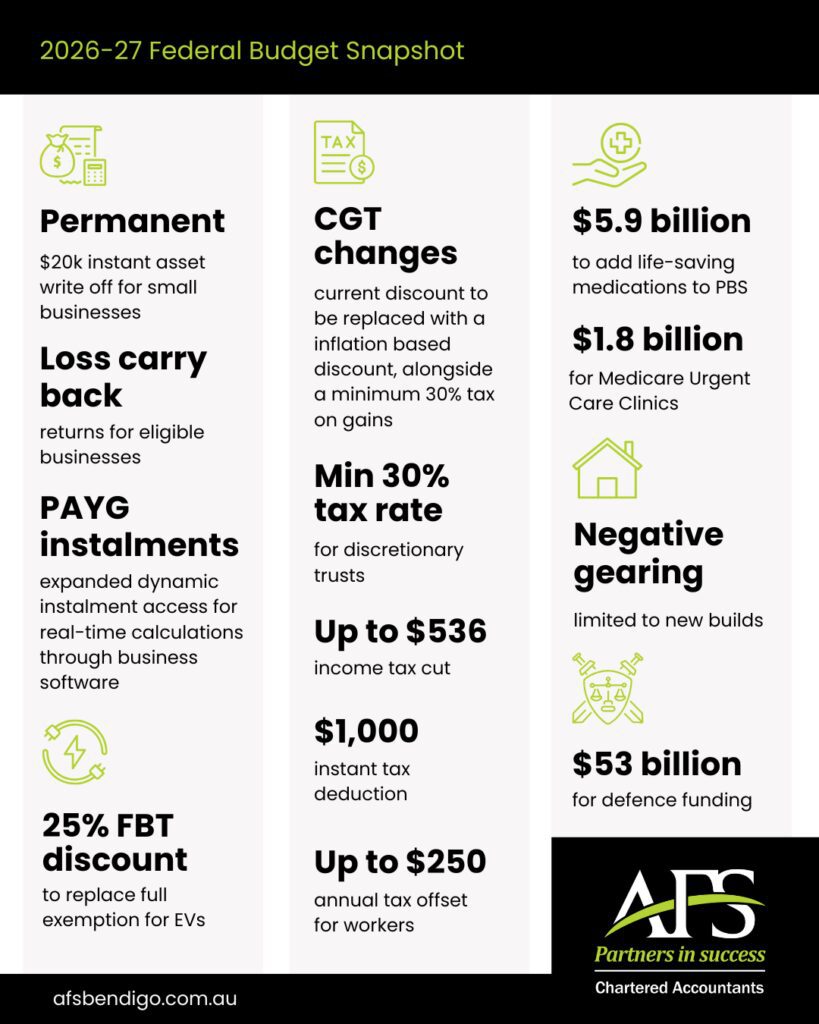
Capital Gains Tax changes – discount changes and exemptions
The Government announced significant proposed changes to how capital gains tax (CGT) will be calculated from 1 July 2027. While some details are still emerging, the changes represent a material shift for long‑term investors.
In summary:
- The current 50% CGT discount will be replaced with an inflation‑adjusted indexation model for assets held longer than 12 months.
- A minimum tax rate of 30% on realised capital gains is proposed (with exemptions for income support recipients, including pensioners).
- The CGT net will be broadened to include pre‑1985 assets for disposals occurring from 1 July 2027.
- Transitional rules will ensure gains accrued up to 30 June 2027 continue to benefit from the 50% discount.
- Investors in new residential property will be able to choose between the CGT discount or indexation with the minimum tax, to preserve housing supply incentives.
These measures are prospective and will only apply to gains arising on or after 1 July 2027.
We have published a more detailed article explaining how the proposed CGT changes are expected to work in practice, including transitional arrangements and worked examples.
Date of effect: The operative date for the CGT changes is 1 July 2027, ie there will be no changes for disposals before that date.

Read our full article on the proposed CGT changes
Limiting negative gearing to new builds
The Government has announced proposed changes to negative gearing arrangements for residential investment properties from 1 July 2027. Under the proposal, negative gearing deductions would generally be limited to eligible new builds, while existing residential investment properties owned at Budget time would remain unaffected until sold.
The proposed changes would restrict rental losses from affected established properties from being offset against salary and wage income, with losses instead carried forward against future residential property income or capital gains.
Several exclusions have also been proposed, including for existing properties owned at Budget time, eligible new builds, certain trusts and superannuation funds, and some housing-related investment programs. Read our full article, proposed negative gearing changes, for a detailed breakdown of this significant proposed reform, including the announced exclusions, transitional arrangements and potential implications for property investors.
Date of effect: The restrictions will apply to properties for the 2027-28 year, subject to the transitional provisions for established properties and new build properties discussed above.

Read our full article on the proposed negative gearing changes
Proposed 30% tax on discretionary trusts explained
From 1 July 2028, trustees of specific trust types will pay a minimum tax of 30% on the taxable income of discretionary trusts. Beneficiaries, other than corporate beneficiaries, will receive non-refundable credits for the tax payable by the trustee.
Exclusions for some types of income are also proposed, including:
- income from assets of discretionary testamentary trusts existing at announcement.
- primary production income
- certain income relating to “vulnerable minors”
- amounts to which non-resident withholding tax applies.
Our proposed 30% tax on discretionary trusts explained article explains how this might look in practice.
This is a major change and the draft legislation will be eagerly anticipated for clearer details.
The Government states that it will provide expanded rollover relief for 3 years from 1 July 2027 to allow small businesses and others that wish to review structures of discretionary trusts and explore other entity types, such as a company or a fixed trust.
Date of effect: The measures will apply from 1 July 2028.

Read our full article on the proposed 30% tax on discretionary trusts
Business

Permanent $20,000 instant asset write-off
The $20,000 instant asset write-off for small businesses with turnover up to $10 million will become permanent from 1 July 2026, allowing eligible businesses to immediately deduct qualifying assets costing less than $20,000. Assets valued $20,000 or more can continue to be placed into the small business simplified depreciation pool.
Reintroduction of the loss carry-back regime
The Government announced it will reintroduce the loss carry-back regime from 1 July 2026 for companies with aggregated annual global turnover of less than $1 billion, subject to the passage of legislation.
Eligible companies would be able to carry back a tax loss and offset against tax paid up to two years earlier, subject to the balance of their franking account. The measure is intended to support business resilience and investment and is expected to benefit up to 85,000 companies each year.
Research and Development Tax Incentive changes
The Government announced reforms to the Research and Development Tax Incentive from 1 July 2028, including:
- lifting the minimum expenditure threshold from $20,000 to $50,000, with research activities valued below this amount required to be undertaken with an approved provider.
- Increase the offset for core R&D expenditure by around 25% to 50%
- Reduce the intensity threshold from 2% to 1.5%
- Remove eligibility of supporting R&D expenditure (eg literature review and equipment maintenance) for the R&DTI
- increasing the turnover threshold for the highest offset rate from $20m to $50m
- Lift the maximum R&DTI expenditure threshold from $150m to $200m.
Loss refundability for start-up companies
The Government announced a proposed loss refundability regime for eligible start-up companies for tax years starting 1 July 2028 onwards. Subject to the passage of legislation, start-up companies with aggregated annual turnover of less than $10 million would be able to utilise tax losses generated within their first two years of operation to access a refundable tax offset. The offset will be limited to the value of fringe benefits tax and withholding tax on wages paid in respect of Australian employees in the loss year.
Expansion of dynamic monthly business tax payments
From 1 July 2027, the Government proposes expanding the ATO’s dynamic PAYG instalments pilot, allowing eligible small and medium businesses to opt into monthly PAYG instalments and use ATO-approved calculations embedded within accounting software to calculate and vary instalments. The measure is intended to better align PAYG payments with real-time business activity and improve cash flow management.

Changes to FBT exemptions for electric vehicles
The Government confirmed it will gradually scale back the full fringe benefits tax (FBT) exemption for electric vehicles (EVs) and replace it with a permanent 25% FBT discount.
There is no change in the current FBT year ending 31 March 2027, and EVs costing $75,000 or less will continue to receive the full FBT exemption until 1 April 2029.
From 1 April 2027, EVs costing more than $75,000 but below the luxury car tax threshold will instead receive a 25% discount on FBT payable, rather than a full exemption.
From 1 April 2029, the full exemption will end altogether, and all eligible EVs below the luxury car tax threshold will receive only a 25% FBT discount rather than the full amount.
Existing leases are not affected, and eligible EVs will continue to be exempt from import tariffs.
Reducing reporting needs for large proprietary companies
The Government will reduce reporting requirements for large proprietary companies by increasing the monetary thresholds to $100 million in consolidated revenue and $50 million in consolidated gross assets. Companies that fall below these new thresholds will no longer be required to lodge an annual audited financial report, directors’ report or sustainability report.

Development of Australia’s business registers
Funding has been allocated to complete the second tranche of uplift to Australia’s business registers, including synchronising director information with ACNC’s Charities Register, linking Director IDs to the Companies Register, uplifting ABN authentication and completing the transition of ABN and superannuation lookup functions to the ATO.
Personal

$1,000 instant tax deduction
A new $1,000 instant deduction for work-related expenses has been introduced from the 2026–27 income year, allowing eligible taxpayers to claim up to $1,000 in deductions without needing to incur or substantiate work-related expenses. Taxpayers with work-related expenses exceeding $1,000 can continue to claim actual expenses under existing rules.
Taxpayers will be able to claim a standard deduction of up to $1,000, but only up to the amount of their assessable labour income. If they also claim work‑related deductions, such as car expenses, travel between jobs, repairs or depreciation the standard deduction will be reduced accordingly so the same expense isn’t claimed twice.
The new standard $1,000 deduction will replace the existing $300 no-receipt threshold and the $150 laundry expense concession, with corresponding provisions and definitions repealed.
Date of effect: These amendments will apply to tax returns for the 2026-27 income year onwards.
$250 working Australians tax offset
The Government has announced a new Working Australians Tax Offset (WATO), providing a permanent $250 annual tax offset for eligible Australians who earn income from work, including wages, salaries and the business income of sole traders. The offset will apply to income earned from 1 July 2027 and will be received when taxpayers lodge their 2027–28 income tax return.
The WATO will increase the effective tax-free threshold for income derived from work by nearly $1,800 to $19,985 (or up to $24,985 for workers eligible for the low income tax offset (LITO).
This offset is in addition to the already-legislated tax cuts that apply from 1 July 2027, and the $1,000 instant tax deduction for work-related expenses from the 2026-27 income year.
Date of effect: The WATO will be available for all workers for tax years starting on or after 1 July 2027, paid automatically in tax returns at the end of the year.
Personal tax rates: no change to previous announcements for 2026-27 and 2027-28
The previously announced tax rate changes announced in last year’s budget will still apply from 1 July 2026 and 1 July 2027. The resident personal income tax rate for the taxable income bracket from $18,201 to $45,000 will reduce from 16% to 15% for the 2026-27 income year, and then to 14% for the 2027-28 and later income years.
The tax rates and income thresholds for residents are as follows:
| Income range | 2025/26 rate | 2026/27 rate | 2027/28 onwards rate |
| $0 – $18,200 | Nil | Nil | Nil |
| $18,201 – $45,000 | 16% | 15% | 14% |
| $45,001 – $135,000 | 30% | 30% | 30% |
| $135,001 – $190,000 | 37% | 37% | 37% |
| $190,001+ | 45% | 45% | 45% |

Medicare levy low‑income thresholds for 2025-26
For the 2025–26 income year, the Medicare levy low‑income threshold for singles has increased to $28,011, up from $27,222 in 2024-25.
For couples with no children, the family income threshold has risen to $47,238 (previously $45,907). The threshold increases by a further $4,338 for each dependent child or student (up from $4,216).
For single seniors and pensioners eligible for the Seniors and Pensioners Tax Offset, the low‑income threshold is now $44,268, compared with $43,020 last year.
The family threshold for seniors and pensioners has increased to $61,623 (up from $59,886), plus $4,338 for each dependent child or student.
Date of effect: The increased thresholds will apply to the 2025-26 and later income years pending a Bill being introduced to parliament.
Reduction to private health insurance rebate over 65’s
From 1 April 2027, the private health insurance rebate for people aged 65 and over will be cut to the same rate as under‑65s, removing higher age‑based rebate tiers.
Date of effect: 1 April 2027
Energy
Fuel security package
The Government has announced more than $10 billion toward fuel security and supply chain resilience initiatives, including fuel reserves, storage infrastructure and supply chain capability investments.
Responding to the global oil shock
In response to the ongoing impacts of the war in the Middle East on oil, fuel and fertiliser supplies the Government have put in place funding or changes including:
- One billion extra litres of petrol and diesel secured so far for March to June
- $7.5 billion Fuel and Fertiliser Security Facility to secure more fuel from international partners
- $3.2 billion Australian Fuel Security Reserve to build long-term fuel resilience
- $1 billion in interest-free loans to help manufacturing and logistics businesses
- Reserving 20% of gas exports for Australians.
Healthcare
Medicare Urgent Care Clinics
The Budget includes $1.8 billion over five years to make Medicare Urgent Care Clinics permanent, supporting ongoing access to free bulk-billed urgent care services and reducing pressure on hospital emergency departments. The funding will support a national network of 137 clinics across Australia.
NDIS reforms and savings measures
The Government announced further reforms aimed at improving the sustainability and integrity of the National Disability Insurance Scheme (NDIS), including additional compliance, fraud prevention and provider oversight measures. The Government states the reforms are expected to save approximately $37.8 billion over the next four years.
Defence
Increased defence spending
An additional $53 billion allocated to defence spending over the next decade, with defence spending expected to increase to approximately 3% of GDP by 2033. Investment is expected to focus on defence capability, infrastructure, drones and long-range missile systems.
Where to get Budget documents
The 2026-27 Budget Papers are available from the following website:
Please note that the measures outlined above in the Federal Budget are contingent on Labor being re-elected.